|
由于GP-B实验对挑战相对论具有重大的意义,从现在起,我计划将所有的进展资料转发到这一论坛来,供需要准确资料的同行了解其进展并参考。由于时间原因,我不能将这些资料翻译成中文,只解释关键部分。需要所有资料的同行只有自己想办法解读了。
GP-B进入了初始化和轨道校验的最后阶段。4个陀螺都已经悬浮好,2、4号已经加速到科学观测所需的速度。望远镜(意味着陀螺)已经定位到远方类星体IM Pegasi。昨天(16日)2号陀螺加速到87Hz(80Hz就已经达到实测要求)。
(后面部分是工程的简况)
At just under 3 months in orbit, Gravity Probe B is nearing the end of the Initialization and Orbit Checkout (IOC) phase of the mission. The spacecraft remains in excellent health, and all subsystems are continuing to perform well. All four gyros are digitally suspended, with gyros #2 and #4 spinning at science mission speed—greater than 80Hz (4,800 rpm)—and gyros #1 and #3 spinning at approximately 1.5 Hz (90 rpm), ready for full-speed spin-up. The updated drag-free thruster control software that was uploaded to the spacecraft three weeks ago to optimize performance of the Attitude and Translation Control system (ATC) is continuing to perform nominally. The spacecraft’s roll rate is 0.52 rpm, and the science telescope is being re-locked onto the guide star, IM Pegasi, following the full-speed spin-up of gyro #2 yesterday.
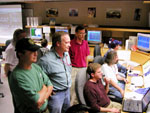 > > 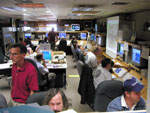 > >
- This past Tuesday, July 13th, Gravity Probe B achieved a major milestone with the successful spin-up of gyro #4 to a science-ready speed of 105.8 Hz (6,348 rpm). Second to the launch, the full-speed spin-up of the gyros has been the next most long-awaited event in the history of GP-B. Members of the team were very attentive at their stations in the Mission Operations Center (MOC) here at Stanford for 3 hours and broke into applause when the final announcement boomed over the MOC intercom that the gyro #4 full spin-up had been completed successfully. Yesterday, July 16th, gyro #2 underwent the same spin-up procedure, reaching a final spin rate of 87 Hz (5,220 rpm). Spinning up the gyros to science-ready speed is a complex and dynamic operation that exercises the full capabilities of the Gyro Suspension System (GSS) and requires a high level of concentration and coordination on the part of the GP-B Team. Following is an overview of the process.
- First, commands are sent to the GSS to move the gyro rotor (sphere) very close to the spin-up channel (about 1/100th of the edge of a sheet of paper) in one half of the gyro’s housing.
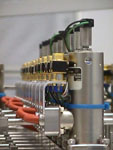
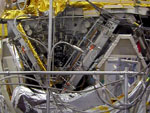 > > 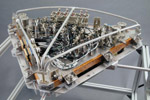 > Ultra-pure (99.99999%) helium gas is streamed from the Gas Management Assembly (GMA), mounted in a bay on the spacecraft frame, through tubing that enters the “top hat” (the thermal interface at the top of the probe) and travels down to the gyro housings in the Science Instrument Assembly (SIA) at the bottom of the probe. As the helium gas descends into the probe, which is at a temperature of approximately 1.8 Kelvin, the gas cools down from 273 Kelvin to around 12 Kelvin. > Ultra-pure (99.99999%) helium gas is streamed from the Gas Management Assembly (GMA), mounted in a bay on the spacecraft frame, through tubing that enters the “top hat” (the thermal interface at the top of the probe) and travels down to the gyro housings in the Science Instrument Assembly (SIA) at the bottom of the probe. As the helium gas descends into the probe, which is at a temperature of approximately 1.8 Kelvin, the gas cools down from 273 Kelvin to around 12 Kelvin.
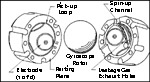
- Before entering the spin-up channel in one of the gyro housings, the gas is passed through a combination filter/heater. The filter, which is made of sintered titanium, removes any impurities that may have been imparted to the helium on its journey into the probe. The heater enables the helium to be warmed slightly, which increases its adhesion to the ultra-smooth surface of the gyro rotor. The filtered and warmed helium then passes through the spin-up channel in one half of the gyro housing, and most of the gas evacuates into space through an exhaust system.
 > However, some of the helium leaks into the housings of the other gyros, causing their spin rates to decrease up to 20% over a full spin-up period of 2-3 hours. > However, some of the helium leaks into the housings of the other gyros, causing their spin rates to decrease up to 20% over a full spin-up period of 2-3 hours.
- For this reason, the order in which the gyros are spun up is very important. Earlier in the IOC phase, the 3 Hz (180 rpm) spin-up provided information on the helium leakage rate of each gyro. Gyro #4, which had the highest leakage rate, was spun-up to full speed first, so that helium leaked from its spin-up would not affect other gyros that were already at science mission speed. The remaining gyros are then spun-up in decreasing order of their helium leakage rates—gyro #2, gyro #1, and finally, gyro #3.
- Each full-speed spin-up takes most of a day. In the morning, helium gas is flowed over the gyro for 90 seconds, and tests are run to ensure that the helium leakage rate for that gyro corresponds to previous measurements. If everything checks out, the full-speed spin-up, in which helium gas is flowed over the rotors for 2-3 hours, commences early in the afternoon. The GP-B team controls the spin-up process by sending commands from the Mission Operations Center (MOC) here at Stanford to the spacecraft in real-time. For example, they send commands to open or close the GMA valves to flow helium through the gyro’s spin-up channel. They also control the amount of heat applied to the gas before it enters the gyro spin-up channel, and they control opening and closing of exhaust valves. Real-time telemetry provides immediate feedback on the progress of the spin-up so that various parameters can be adjusted as necessary.
 > >
- The successful spin-up of gyro #4 to full speed enabled us to spin-up gyro #2. Gyro #2 topped out at 87 Hz (5,220 rpm), which is only slightly above the minimum spin rate of 80 Hz (4,800 rpm) required for the science experiment. Also, the helium gas leakage from the Gyro 2 spin-up slowed gyro #4 down to 91Hz (5,460 rpm). We are taking some time to evaluate the data from the first two spin-up procedures and to perform some ground-based tests before spinning up gyros #1 and #3 to full speed.
- Meanwhile, we are fine-tuning the drag-free software used by the Attitude and Translation Control system (ATC) to optimize its performance at the current and final spacecraft roll rate of 0.52 rpm. For part of each orbit, the spacecraft passes behind the Earth, causing the telescope to lose visual contact with the guide star. During this “eclipse” period, two standard external rate gyroscopes, plus the star trackers on either side of the spacecraft, enable the ATC to keep the spacecraft/telescope pointed towards the guide star. When the spacecraft emerges over the North Pole and the guide star becomes visible again, the telescope must be re-locked onto it. This re-locking has been taking up to 15 minutes, and the fine-tuning will speed up this process considerably.
※※※※※※
hgy |